







Use FOUNDER100 for $100 off — first 100 purchases only
Ship a production-ready AI chatbot in days, not months
The Next.js boilerplate that gives you a ChatGPT-quality chatbot out of the box. Streaming, tool use, memory, auth, billing, rate limiting — everything wired up and ready to deploy.
Next.js
Tailwind CSS
Stripe
Google Gemini
OpenAI
Anthropic
Resend
Docker
Railway
Upstash
Next.js
Tailwind CSS
Stripe
Google Gemini
OpenAI
Anthropic
Resend
Docker
Railway
Upstash
Next.js
Tailwind CSS
Stripe
Google Gemini
OpenAI
Anthropic
Resend
Docker
Railway
Upstash
The Problem
You've built this before. It took weeks.
Every AI chatbot project starts with the sameweeks of plumbing before you write a single prompt.

Weeks of plumbing before your first prompt

Auth, billing, rate limiting, token tracking, email — every chatbot starts with the same infrastructure grind. You spend weeks wiring APIs together before you can even test a conversation.

The UX your users expect is deceptively hard

Stop and regenerate. Edit and resubmit. Streaming that actually works. Conversation history that doesn't break. The interaction patterns people expect from ChatGPT are a nightmare to build from scratch.

Then comes the real scope

Tool use. Persistent memory. File uploads. Team management. Role-based access. Once your chatbot needs to do more than talk, you're building a platform — and you're months away from shipping.

Without hourzero.dev
Weeks spent on auth and billing plumbing
Fragile streaming implementation
No conversation compaction — context windows blow up
Building tool use from scratch
File uploads hacked together last minute
RBAC bolted on as an afterthought
Months before your first deploy
With hourzero.dev
Deploy a working chatbot on day one
Battle-tested streaming with stop, regenerate & edit
Automatic thread compaction keeps costs down
Full tool suite — search, retrieval, code execution
S3-compatible file management built in
Enterprise-grade RBAC and organizations out of the box
Ship to your first customer this week
Features
Everything you need to ship a chatbot product
Not a starter template. A production-grade codebasewith every feature already wired up.

A real-time conversational UI built to the standard your users already expect. Streaming responses appear token by token. Users can stop generation mid-stream, regenerate any response, edit messages and resubmit, copy to clipboard, and leave feedback. The model selector lets users switch between providers on the fly. Automatic thread compaction keeps long conversations viable — the system compresses earlier context so chats continue indefinitely without blowing up costs.
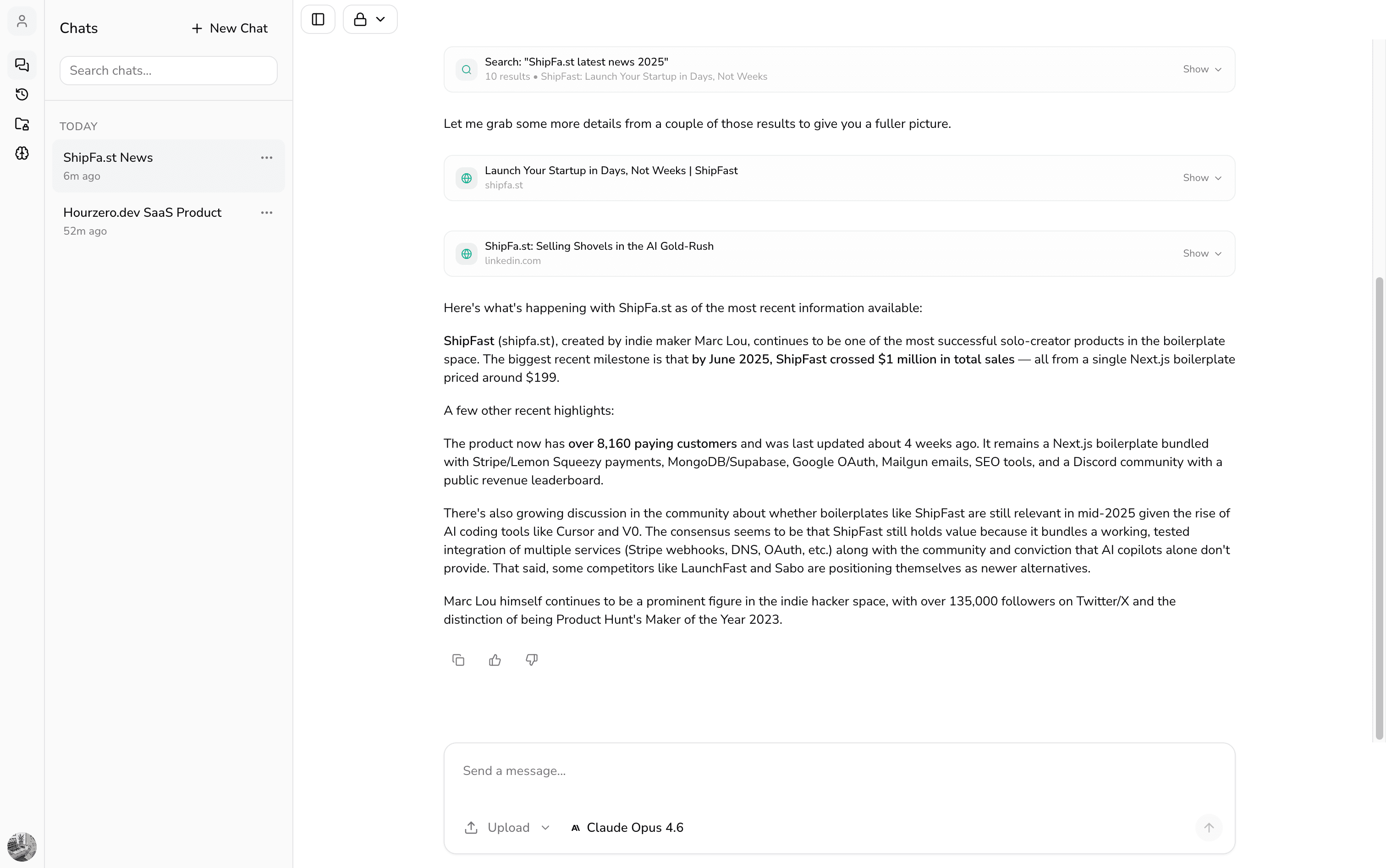
The core chat experience
How It Works
From clone to production in three steps
No complicated setup. No sprawling documentation.Just clone, configure, and deploy.
01

Clone the repo

Pick your tier, get instant access to the private GitHub repo, and clone it locally.

02

Configure your stack

Set your environment variables for Stripe, Upstash, Resend, and your AI provider. The documentation walks you through each one.

03

Deploy

Push to Vercel, Railway, or anywhere with Docker support. Your chatbot is live — ready for your first users.

Tech Stack
Built on the stack you already know
Production-grade tools you trust, wired togetherso you can focus on your product.
Next.jsTailwind CSSStripeGoogle GeminiOpenAIAnthropicResendDockerRailwayUpstash
Why I Built This
From the founder

I got tired of rebuilding the same chatbot infrastructure from scratch — auth, streaming, billing, rate limiting — project after project, week after week, before I could focus on the features that actually differentiate a product.

Here's what I believe: chatbots are the next CRUD app. Every small and medium business will want a bespoke AI assistant, and indie devs are perfectly positioned to build them. But the infrastructure beneath every chatbot is about to be completely commoditized — auth, billing, streaming, rate limiting will be table stakes. The devs who win won't be the ones who wired up Stripe the fastest. They'll be the ones who shipped a differentiated product while everyone else was still building plumbing.

hourzero.dev is the boilerplate I wished I'd had. Not a toy — a production-grade foundation with streaming, tool use, memory, file management, billing, and full multitenancy with team management, roles, and access control. Everything wired up and ready to ship to your first customer.

Skip the infrastructure. Ship what makes your product different.

B
Bogdan Aioanei
Founder, hourzero.dev
Pricing
Simple pricing. No subscriptions.
Pay once, own the code forever. Lifetime updates included.
Use codeFOUNDER100for $100 off
Limited to the first 100 purchases
Starter
For solo devs shipping their first chatbot
$299
one-time payment
FOUNDER100→ $100 off at checkout
Get Starter
Streaming chat UI with real-time responses
Multiple AI model selection (OpenAI, Anthropic, Gemini already integrated)
Stop, regenerate, edit & resubmit messages
Feedback and copy quick actions
Battle-tested system prompts
Chat history management
Automatic chat thread compaction - no need for an API vendor lock-in (like Anthropic API), you own the compaction layer and can reuse it across providers
Integrate with any Postgres database, managed (PlanetScale, Supabase, Neon etc.) or self-hosted
Email integration via Resend
Stripe subscription billing
Upstash rate limiting & token limits
Better-Auth authentication
Docker deployment support
Full Next.js codebase
Pro
Most Popular
For devs building production chatbots with real capabilities
$379
one-time payment
FOUNDER100→ $100 off at checkout
Get Pro
Everything in Starter
SERP tool — google search the web
Webpage retrieval tool — scrape and read full webpages
Web snippet search tool — directly retrieve relevant snippets from webpages
Code execution in sandbox
File uploads (S3-compatible) — Railway Storage is pre-configured
File management + reusable files across conversations
Persistent chatbot memory
Enterprise
For teams and agencies building chatbots for clients
$599
one-time payment
FOUNDER100→ $100 off at checkout
Get Enterprise
Everything in Pro
Role-based access control (RBAC)
Organizations & team management
Configurable user roles
User invites
Usage tracking & analytics
File sharing among org members
Google Auth
Lifetime updates
Use on unlimited projects
No hidden fees. No subscriptions. Here's how it works.
One-time payment — not a subscription
Lifetime updates included for your tier
No seat license — use on unlimited projects
Full source code — you own it completely
Instant access via private GitHub repo
Comprehensive docs and deployment guides

Third-party service costs are separate: AI provider tokens (OpenAI/Anthropic/Google), Postgres hosting, Stripe fees, Upstash, Resend, and S3 storage. All have free tiers for development.

Taxes may be applied at checkout for customers in European countries
Newsletter

Stay in the loop

Get product updates, new feature announcements, and tips on shipping AI products faster.

No spam, unsubscribe at any time.

Frequently Asked Questions
Everything you need to know about the boilerplate.
General
Instant access to a private GitHub repo containing the full Next.js codebase, detailed documentation that walks you through setup and configuration, and lifetime updates. Everything is yours — you clone it, configure it, and deploy it.
A boilerplate is a pre-built codebase that handles the common, repetitive parts of building an application — things like authentication, billing, database setup, and UI scaffolding. Instead of spending weeks wiring all of this together from scratch, you start with a working foundation and focus your time on the features that make your product unique.
It's a production-ready codebase, not a visual template. The chatbot works out of the box once you set your environment variables. You're getting working auth, billing, streaming, chat management, and (depending on your tier) tool use, memory, file management, and team features — all wired together and ready to deploy.
Any developer who wants to ship an AI chatbot product without spending weeks or months on infrastructure. Whether you're a solo indie dev building your first SaaS, a freelancer building chatbot products for clients, or a team that needs a multitenant chatbot foundation — hourzero.dev gives you a massive head start.
Tech Stack & Requirements
Next.js, TypeScript, Vercel AI SDK, OpenAI, Anthropic and Gemini models, TailwindCSS, Better-Auth, Stripe, Upstash Redis, Postgres, Resend, and Docker. The Pro and Enterprise tiers also include Railway S3-compatible storage integration. Enterprise adds Google Auth.
You should be comfortable with React and have at least a basic understanding of Next.js. The codebase is written in TypeScript and uses the App Router. If you've built a Next.js project before, you'll feel right at home. If you're brand new to Next.js, you'll still be able to follow the documentation, but expect a learning curve.
TypeScript throughout. The entire codebase is fully typed.
The boilerplate is designed to work with any Postgres database. Regardless whether it's a managed service like PlanetScale, Supabase, Neon or self-hosted with Docker, the boilerplate is designed to work with any Postgres database.
Yes. The codebase runs on any operating system that supports Node.js. Docker support is also included if you prefer a containerized development environment.
The boilerplate integrates with the Vercel AI SDK, which supports OpenAI, Anthropic, Google, Mistral, and many other providers. The model selector in the UI lets end users switch between any models you configure. Adding a new provider is as simple as adding its SDK and updating the configuration.
Features & Architecture
When a conversation crosses a configurable token threshold, the system automatically summarizes the earlier messages into a compressed context and continues the conversation from there. This keeps your API costs down and prevents context window overflows — the conversation can continue indefinitely without degrading response quality or blowing up your bill. The compaction is designed to integrate beautifully with the Prompt Caching systems that many AI providers offer (e.g. OpenAI, Anthropic, Gemini, etc.).
The Pro and Enterprise tiers include pre-built tools — web search (SERP), webpage retrieval, web snippet search, and sandboxed code execution. The chatbot can invoke these tools mid-conversation to fetch information, read pages, or run code. Each tool can be toggled on or off. The system is built on the Vercel AI SDK's tool calling interface, so adding your own custom tools is straightforward.
The Pro and Enterprise tiers include a memory system that lets the chatbot store and recall information across separate conversations. This means users don't start from zero every time they open a new chat — the chatbot can remember preferences, past context, and key facts from earlier sessions. The user can also directly manage the memory bank, by adding, editing, deleting and searching for memories.
Users can upload files to any S3-compatible storage provider. The boilerplate comes pre-integrated with Railway's S3-compatible solution, but you can swap in AWS S3, Cloudflare R2, MinIO, or any other compatible provider. Files are browsable, manageable, and reusable across conversations.
The Enterprise tier includes full organization support — you can create organizations, invite members, assign roles, and control access with role-based permissions. Members within the same organization can share files. Usage tracking gives you per-user, per-team and per-organization analytics. Google Auth is included for frictionless team onboarding.
Upstash is used for both rate limiting and token usage tracking. You can configure limits per user, per time window, and per token budget. This protects your API costs and lets you offer different usage tiers to your end users if you're building a SaaS on top of the boilerplate.
Opinionated where it saves you time, flexible where it matters. The auth, billing, rate limiting, and streaming infrastructure follow proven patterns and are tightly integrated. But the business logic, UI, prompts, tool definitions, and data models are all yours to modify. You're not locked into a rigid framework — it's a well-structured starting point, not a black box.
Yes. The tool system is built on the Vercel AI SDK's tool calling interface. Adding a custom tool means defining its schema and handler function. The existing tools (SERP, retrieval, code execution) serve as working examples you can follow.
Customization & Flexibility
Fully. The frontend is built with React shadcn/ui components and Tailwind CSS. You can restyle, rearrange, or completely redesign every part of the interface. The chat UI, sidebar, model selector, settings panels — all of it is yours to modify.
The boilerplate uses Better-Auth, which is flexible and well-documented. You could swap it for another provider, but it would require reworking the auth integration. For most use cases, Better-Auth covers everything you need out of the box — email/password, magic links, and Google Auth (Enterprise tier).
Stripe is deeply integrated for subscription billing, webhook handling, and checkout. Replacing it with another provider like Lemon Squeezy or Paddle is possible but would require rework of the billing flow. Stripe is the recommended path.
Yes. The file upload system is built against the standard S3 API. You can use AWS S3, Cloudflare R2, MinIO, DigitalOcean Spaces, or any other S3-compatible service — just update the configuration.
Yes. The boilerplate ships with battle-tested default prompts, but they're just strings in your codebase. You have full control to rewrite, extend, or dynamically generate them based on your use case.
Setup & Deployment
Most developers are up and running in under an hour. Clone the repo, set your environment variables (Stripe keys, Upstash credentials, Resend API key, AI provider keys), and deploy. The documentation walks you through every step.
API keys for your AI provider (OpenAI, Anthropic, etc.), Stripe keys and webhook secret, Upstash credentials, Resend API key, database connection string, and S3 credentials if you're on the Pro or Enterprise tier. Everything is documented with step-by-step instructions.
Yes. The boilerplate includes Docker support, so you can deploy to Vercel, Railway, AWS, Fly.io, or any platform that supports Next.js or Docker containers.
Yes — the boilerplate integrates with external services that have their own pricing. Stripe, Upstash, and Resend all have generous free tiers that will cover you during development and early usage. Your AI provider (OpenAI, Anthropic, etc.) charges per token. S3 storage costs are minimal. You won't need to spend anything beyond the boilerplate purchase to get started, but production usage at scale will incur costs from these providers.
Yes. The boilerplate comes with detailed documentation covering setup, configuration, environment variables, deployment, architecture overview, and how to customize each major feature. It's designed to get you from clone to deploy as quickly as possible.
Pricing & Licensing
Starter gives you the core chatbot — streaming, auth, billing, rate limiting, chat history, thread compaction, and email integration. Pro adds tool use (web search, page retrieval, code execution), file uploads, persistent memory, and file management. Enterprise adds everything in Pro plus RBAC, organizations, team management, user invites, usage analytics, file sharing, and Google Auth.
Yes. Contact me and I'll arrange the upgrade for the price difference between your current tier and the one you're moving to.
Founder pricing expires and prices increase to their regular rates: $299 for Starter, $379 for Pro, and $599 for Enterprise. If you buy during the founder window (use code FOUNDER100 at checkout), you keep the discounted price — it's a one-time payment either way.
One-time payment. You pay once and own the code forever. There are no recurring fees, no seat licenses, and no usage charges from hourzero.dev.
Yes. Every tier includes lifetime updates at no additional cost. As the boilerplate improves, you get access to every update for your purchased tier.
Yes. You can use the boilerplate on unlimited projects, including products you build and sell to clients. If you're delivering source code to a client, review the license for specifics on how that works.
No. You're buying the right to use the code in your own projects and products. Redistributing or reselling the boilerplate source code is not permitted.
Due to the nature of digital products with immediate access to source code, refunds are not available. If you have questions before buying, reach out — I'm happy to answer anything.
Security & Scaling
The boilerplate follows security best practices — CSRF protection, secure session handling, environment-based secret management, rate limiting to prevent abuse, and scoped API routes with proper auth checks. That said, you are responsible for your own deployment security, keeping dependencies updated, and following best practices for your hosting environment.
Yes. The boilerplate is built on Next.js, which scales well on platforms like Vercel, Railway, and AWS. Rate limiting via Upstash protects against abuse. Token usage limits prevent runaway API costs. The architecture is designed for real production use, not just demos.
Minimal. Next.js runs anywhere Node.js runs. The AI SDK supports multiple providers, so switching between OpenAI, Anthropic, or others is a configuration change. S3-compatible storage is a universal standard. The most integrated services are Stripe, Upstash, and Better-Auth — replacing any of those is possible but requires more effort.
Support & Community
You can reach me at bogdan@hourzero.dev or via DM on X/Twitter. I also plan to set up a Discord community for buyers to share tips, ask questions, and get support.
Not at this time. The boilerplate is designed to be self-serve with thorough documentation. If that changes, I'll announce it to existing customers first.
Email me at bogdan@hourzero.dev or DM me on X/Twitter. I respond to everything.
Stop building chatbot infrastructure & plumbing.Start shipping chatbot products.
© 2026 hourzero. All rights reserved.